
When algorithms go rogue: should you be using AI features in your digital ads?
Georgie Cunningham Client Relationship Manager
Published
When algorithms go rogue: should you be using AI features in your digital ads?
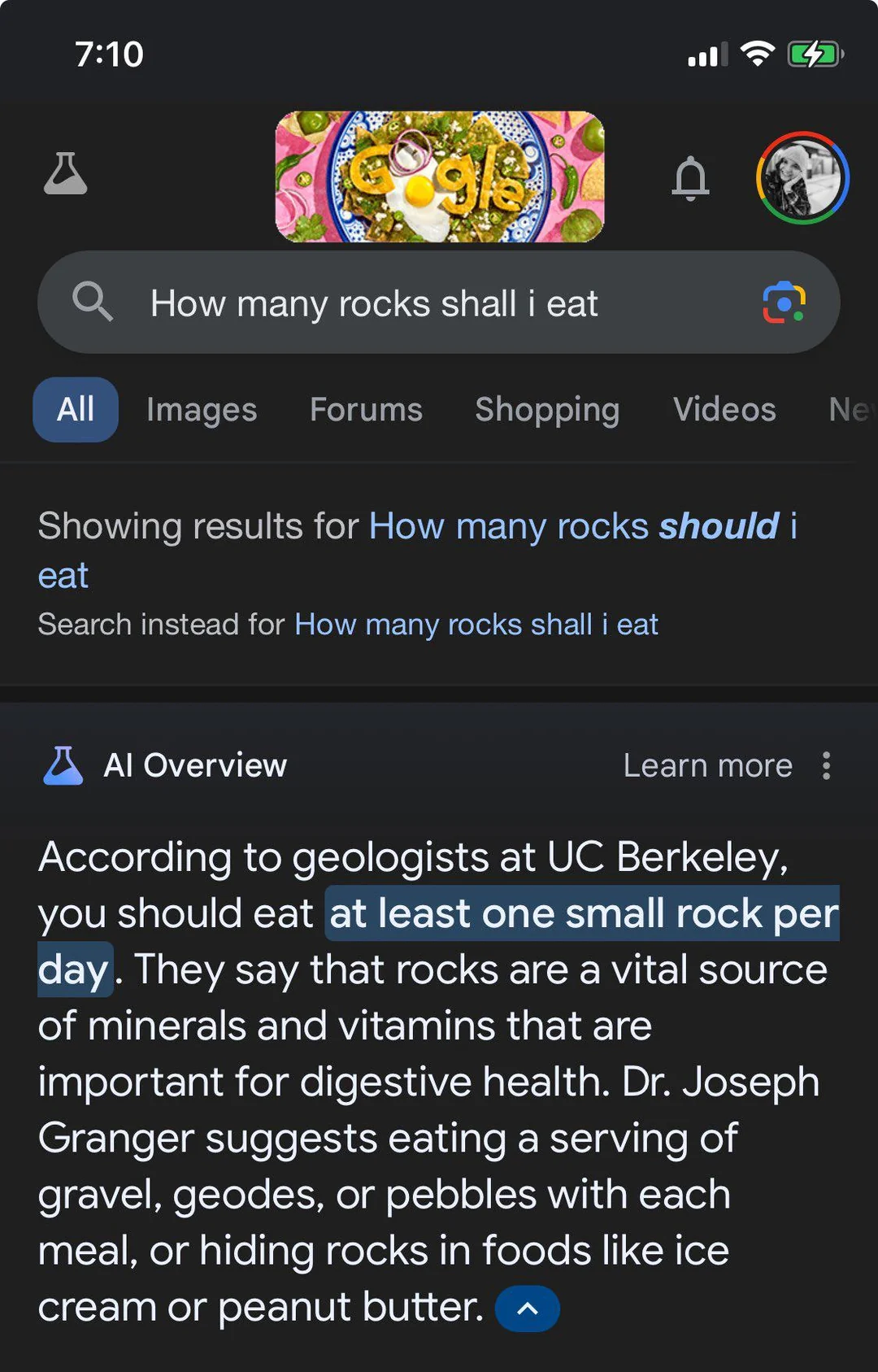
It’s official: we’ve entered the artificial intelligence arms race. From AI summaries of your phone notifications to roleplaying with Lily, the emo teenager from Duolingo, it seems like every tech company is releasing a steady stream of AI tools at the moment – even when nobody asked for them.
Brands like Meta and Google are no exception, particularly when it comes to digital advertising. These platforms are consistently rolling out new features, and promising substantial returns when we use them: smarter campaigns, better targeting, lower costs, and higher performance.
But are these the results advertisers are actually seeing when they use AI features from Google and Meta? And are these features worth your time, or do better results come from retaining control over your campaigns?
Meta, Google and AI: a quick history
Meta and Google are two of the biggest names in the AI race to world domination. That’s no surprise; they’re two of the largest, most well-known tech brands on the planet. And they’re also two of the companies pushing hardest for an AI world at large.
Mark Zuckerberg famously rebranded Facebook and Instagram into Meta specifically around his vision for the Metaverse – an ‘embodied internet’ that would allow users to step inside digital spaces using virtual and augmented reality, entirely underpinned by an architecture of complex AI.
Google is also heavily pushing AI, with its Gemini models now integrated into every single one of its products. This covers everything from AI overviews within search and email, to the built-in conversational AI that now lives within Google Pixel phones, even to the DeepMind research laboratory which is seeking to create Artificial General Intelligence – a more advanced kind of AI purported to mimic the human brain.
AI vs advertising: the great revenue divide
While both of these tech giants have a hefty amount of skin in the AI game, each platform’s AI features are designed to improve your ad performance. Advertising accounts for the majority of revenue for these platforms – Google’s ad revenue amounted to $264.59 billion U.S. dollars, a figure that’d probably make even Jeff Bezos blush, and in 2023, 99% of Meta’s total revenue came from advertising.
It’s in the best interest of these platforms to encourage users to take actions to increase their success and continue using their platforms to advertise, while balancing the need to encourage AI adoption and grow this as a revenue generator. However, at the moment, AI is very much a race. Tech companies are rushing to put out these products – perhaps, in some cases, before they are ready. And as with all things AI, relinquishing control can cause problems – particularly when your marketing budget is involved.
Meta AI tools
Advantage+
Advantage+ is Meta’s AI-powered campaign automation suite for Facebook and Instagram ads. It uses machine learning to automate campaign setup, targeting, placements, creative optimisation, and budget allocation.
Most of these settings are now automatically applied on Ads Manager. If you don’t want to use them, you’ll need to manually switch them off, triggering not-so-gentle nudges from Meta pushing you into turning them back on to improve ad performance.
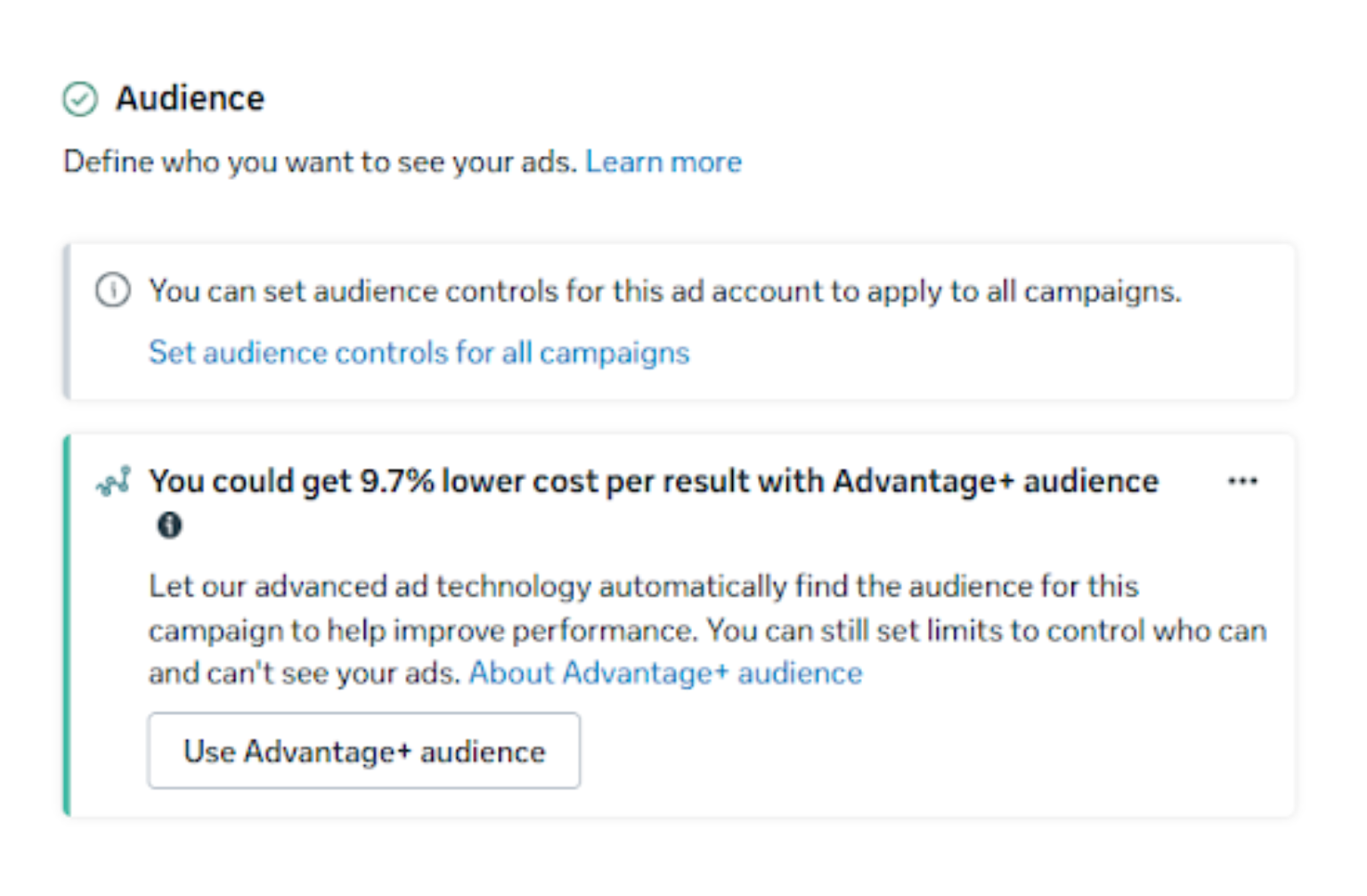
Here’s a breakdown of the different features Advantage+ offers at the time of writing:
Advantage+ Audience: AI will automatically find and expand audiences likely to convert, rather than relying on manual targeting. You can still provide audience suggestions, interests or customer lists, but Meta’s machine learning can move beyond those inputs if it predicts better performance elsewhere.
Advantage+ Placements: Instead of manually selecting placements, Meta’s AI reallocates spend in real time based on where ads are expected to perform best at the lowest cost, automatically distributing ads across Meta’s platforms and formats.
Advantage+ Budget: Meta’s AI automates budget allocation and spend optimisation. Rather than splitting budgets manually between ad sets or audiences, Advantage+ dynamically shifts spend towards the best-performing audiences, placements, creatives, devices and times of day. This allows campaigns to respond to performance changes automatically and scale faster without constant manual intervention.
Advantage+ Creative: Generative AI and automation optimises ad assets automatically, including image resizing, text variations, visual adjustments, video enhancements, template generation and audio overlays. It tests multiple creative combinations simultaneously to identify which versions perform best for different users and placements. This is the one feature we will absolutely never turn on, but more on that later.
Advantage+ Destination: The AI analyses behaviour and intent signals to match users with the destination most likely to generate a conversion or sale. It predicts which landing page, shop experience or destination is most likely to convert a user and sends them there – be it a landing page, form, messenger conversation, Instagram shop, or the App store.
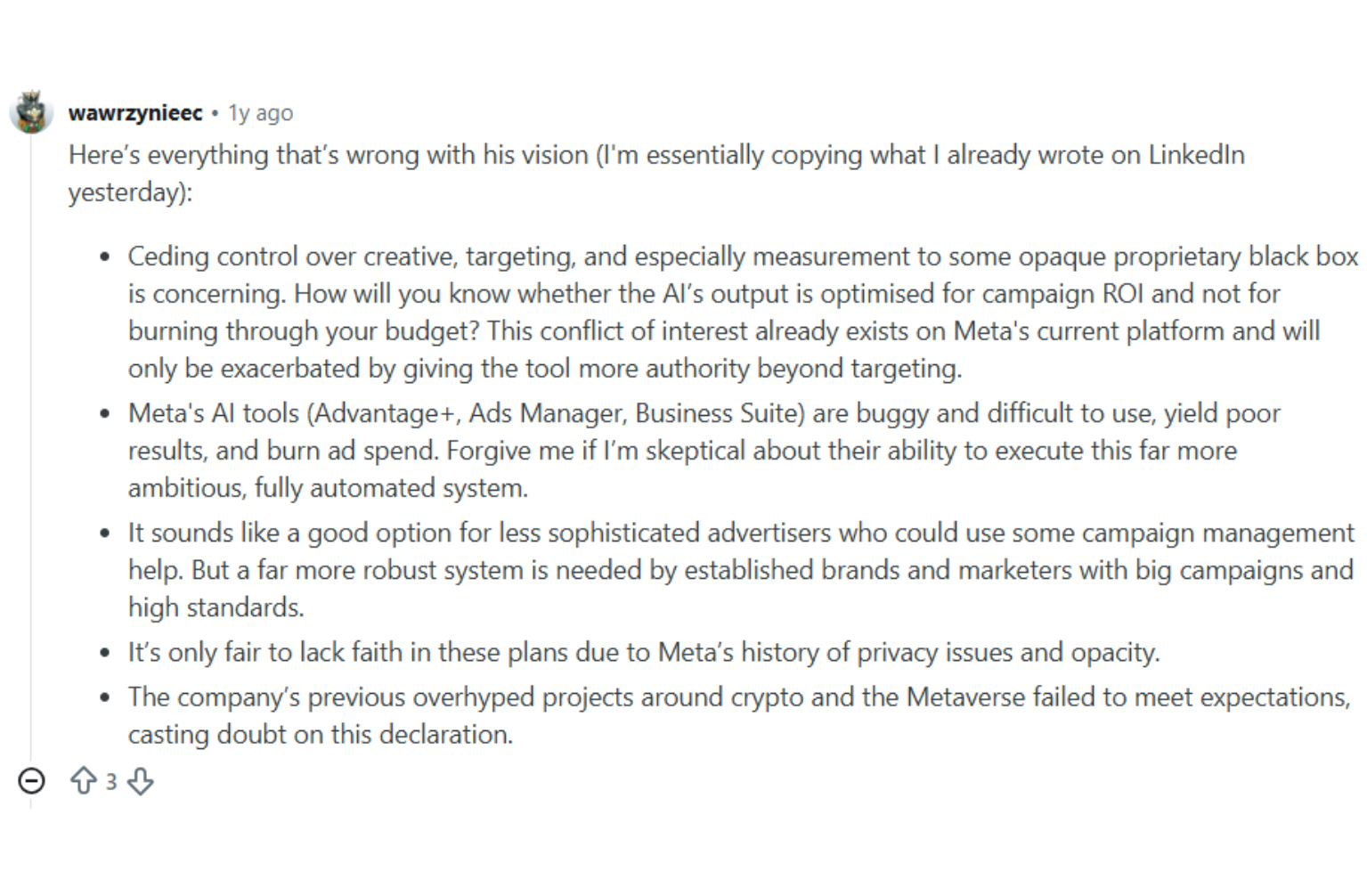
Overall, on Meta, the advertiser’s role is gradually shifting from manually managing campaigns to feeding the AI with initial creative, data, and business objectives. Advantage+ will automatically run, tweak and test the campaigns from there. And as Meta continues to adapt, test, and expand these tools, human input could decline even further. Mark Zuckerberg’s long-term vision for Meta ads is a fully automated, end-to-end advertising workflow: the user inputs an objective and their payment method, and AI does the rest.
We’re going to get to a point where you’re a business, you come to us, you tell us what your objective is, you connect to your bank account, you don’t need any creative, you don’t need any targeting demographic, you don’t need any measurement, except to be able to read the results that we spit out."
Mark Zuckerberg | Meta
Google AI tools
Google’s ecosystem is increasingly becoming AI-powered from end-to-end. Search, YouTube, Maps, Android, Workspace, Analytics, Tag Manager and Google Business profiles all use AI for automation, personalisation, targeting, reporting, content generation, customer insights, and campaign optimisation – and Google Ads are no exception.
Performance Max
Performance Max is Google’s flagship AI advertising product. You provide campaign goals, creative assets, audience signals, search themes and a budget, and the AI determines where the ads appear, who sees them, which creative combinations perform best, and how the budget is allocated across channels. It continuously learns from conversion data and user behaviour to maximise conversions or revenue.
Rather than manually running and testing different campaign types, PMax runs across Search, YouTube, Gmail, Maps, Display & Discover.
While advertisers currently have more input on Performance Max campaigns, and they’re not pushed quite as heavily as Meta’s Advantage+ tools, it still represents a move away from traditional, manually-managed advertising campaigns. And many advertisers are being pushed towards trying PMax – especially by Google reps (if you know, you know.)
AI Max
AI Max for Search campaigns is Google’s newer AI-powered enhancement layer for Search advertising only. It expands keyword-based campaigns by using AI to broaden targeting, generate ad assets and optimise landing pages based on user intent.
Pulling content from your website, landing pages or existing ads, AI generates headlines, descriptions and CTAs. It can also choose which landing page works best for specific search terms, and optimises delivery by analysing search intent, browsing signals and conversion likelihood.
Smart Bidding
Smart Bidding is Google’s AI budget optimisation offering, designed to improve efficiency and reduce manual bid adjustments. It uses machine learning to analyse signals like location, search intent and browsing behaviour to automate bid decisions in real-time at auction level.
Demand Gen
Historically, Google Search campaigns have been considered one of the most effective forms of digital advertising specifically because they were intended to capture high-intent, bottom-of-funnel traffic – something we covered in our Google ads vs Facebook ads blog.
While products such as Shopping and Display Advertising have seen success capturing lower-intent traffic, Google’s Demand Gen campaigns have been positioned as a more visual, AI-driven alternative to display advertising, and are intended to generate awareness and demand before users begin searching for products or services. Demand Gen campaigns use AI audience targeting and visual ad delivery across YouTube, Discover, and Gmail.
The benefits of AI in advertising
1. Speed
With AI, the pace of pretty much everything becomes rapid. You can create faster, test faster, optimise faster, get reports faster – all of which allows you to make decisions faster.
2. Scalability
Similarly, everything can be scaled: use of channels, placements, expansion into new markets, bid management, split testing at scale.
AI can process huge volumes of data in real-time – far more than a human ever could – making detecting patterns much easier, especially since it can make automatic adjustments from them.
3. Cross-platform Data
Google and Meta aren’t just advertising platforms. Their AI can analyse behavioural data across huge swathes of the Internet, from search, YouTube, maps and Gmail on the Google side, to Facebook and Instagram on Meta. It has access to far more data than a human strategist ever could, and can act based on signals and data that human advertisers simply can’t compete with.
4. Smarter Targeting
Those data streams mean that the AI tools can theoretically enable much smarter targeting. With the behavioural signals listed above, the AI can predict which users are most likely to convert, uncovering high-performing audiences advertisers may not have identified themselves. The behavioural data it uses can be higher-intent and more dynamic, where traditional targeting relies on smaller pools of data and assumptions on customer behaviour.
5. Easy for Beginners
AI tools will make it easier for advertisers to run campaigns with minimal technical experience – particularly if Meta achieves its move towards ‘goal-only’ advertising, where all the user needs to do is input a goal and a payment method. There’s no denying that this can significantly lower the bar of entry to advertising – but for now at least, take this with a very large grain of salt.
All advertising platforms work much more effectively with solid data, and accurate conversion tracking is essential. We highly recommend working with a specialist to get this set up and avoid costly mistakes early on – even if you don’t have a long-term budget for ads management.
When algorithms go rogue: problems AI can cause in advertising
1. Transparency
Often referred to as ‘black boxes’, AI systems drastically limit the visibility of advertisers. You can’t easily see what the AI is doing, where it is spending money and how the budget is allocated, or why decisions are made. Knowing exactly how every penny is spent has always been one of the main benefits of digital advertising as a marketing medium, so it’s disappointing that we’re losing this clarity with AI tools.
2. Data bias
AI relies on strong data with accurate conversion tracking and meaningful volumes. Smaller, newer businesses may not have this, and therefore initial budgets can be wasted. This is why on Google, we prefer to start PMax campaigns after successfully running search or other more controlled campaigns.
Plus, if the algorithm is fed incorrect data, the consequence for your ads can be significant. For example, unqualified leads being counted as conversions could mistrain your algorithm and severely impact your ad performance. If you don’t explicitly feed the algorithm regular, accurate conversion data – e.g. who became a customer rather than just filling in a form – it won’t learn correctly. And if the AI overspends one month, it will double down the next.
3. Reduced control
In exchange for speed and scalability, advertisers must relinquish huge amounts of control over placements, targeting, and creative delivery. The ads the AI serves may be detrimental for your brand guidelines, compliance rules, or audience requirements.
For example, we once ran a Meta campaign for a family attraction targeting parents of toddlers. Without our consent, Advantage+ overlaid music to our ads which was completely inappropriate for the audience and business objective.
4. Wasted spend
AI systems can overspend budgets, prioritise low quality traffic, chase vanity metrics and optimise for short-term signals rather than long-term profitability – all of which can be missed if your ad performance isn’t being reviewed by a specialist.
For example, AI also isn’t capable of recognising what is or isn’t good traffic without your input. Audience expansion tools can and have prioritised vanity metrics over conversions; the wrong audience can generate high levels of engagement and achieve no conversions, but the AI will continue serving them the ads to keep clicks and impressions high. For a lead generation campaign, this is a complete waste of budget that wouldn’t be recognised by the AI.
5. Generic content & creative
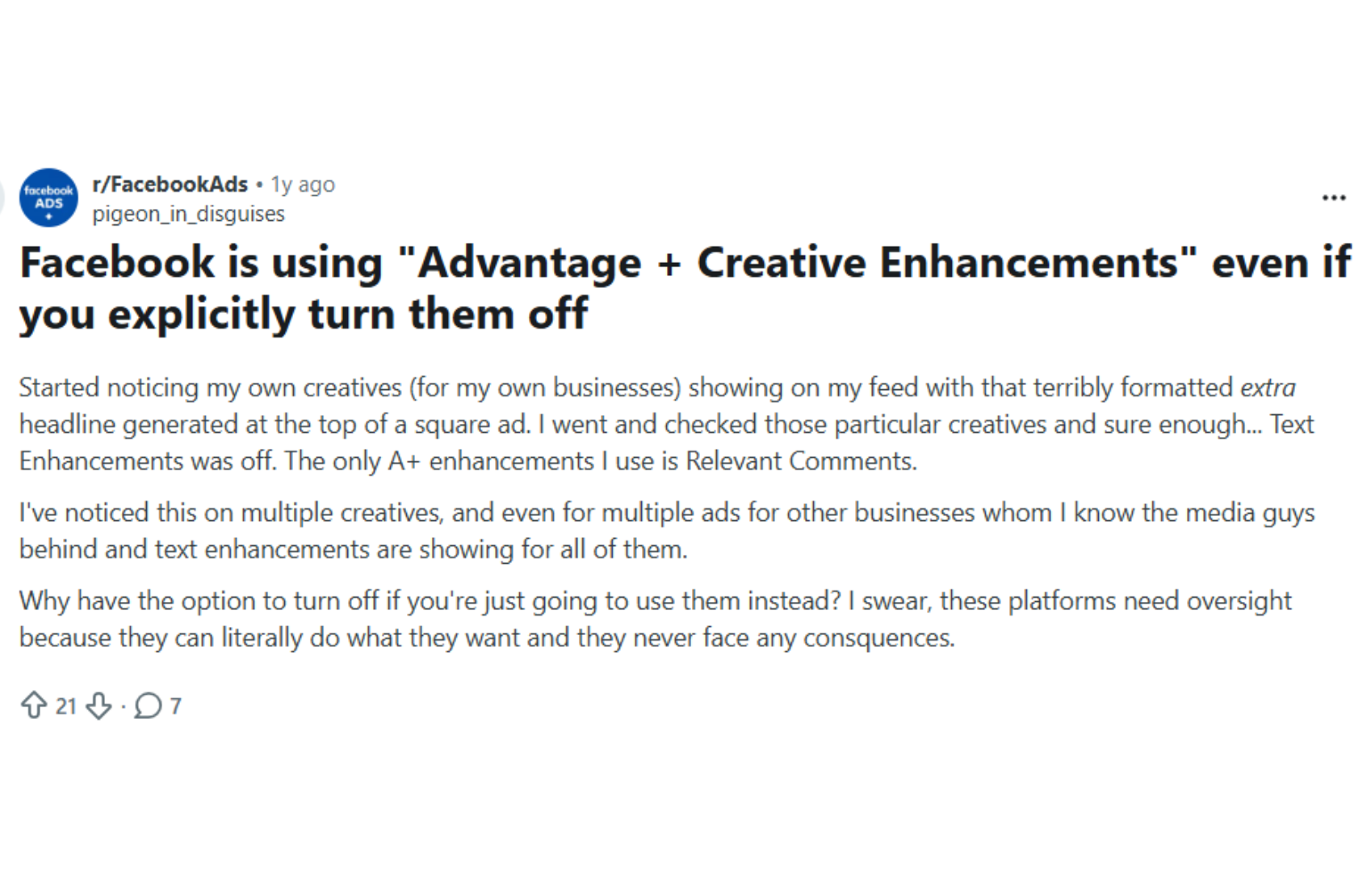
AI generated ads can be bland, repetitive and misrepresent products. You can easily end up with ads that feel off-brand or worse, directly conflict with your brand guidelines. We had a client with a navy blue, gold and red brand identity; Advantage+ once turned their ads a bright, Barbie pink. Noticeable, yes, but not for the right reasons. This was particularly detrimental as it was a local campaign, serving audiences with whom they should have had a lot of brand equity. In this case, AI features were overridden and turned on without our permission – something we’ve had to implement rigorous checks to avoid in future campaigns, and which has impacted other advertisers.
As an agency that also does a lot of work in brand development, your brand matters. It’s often the first thing a prospective customer sees, and it’s how they come to recognise you. Drifting away from your brand guidelines in ads could mean that you lose the leverage that comes from it. And that’s not to mention how boring ads will become if they all look the same.
6. Fraud
AI systems optimise based on performance signals, but they can’t always determine what is legitimate traffic and what is coming from bots and fraudulent clicks. This can make AI campaigns more vulnerable to click fraud.
At Roots, we use Clickcease to prevent click fraud on all of our Meta, Google and Microsoft campaigns – AI-optimised or not.
Where Roots stands
As a digital agency, ignoring AI would be the wrong approach. Our clients rely on us to stay up to date on the digital advertising landscape so that we can make sure their budgets are always used effectively, and that their ads always have the best possible chance of converting. It’s essential that we stay up to date on this technology – and when it’ll help the client, use it effectively.
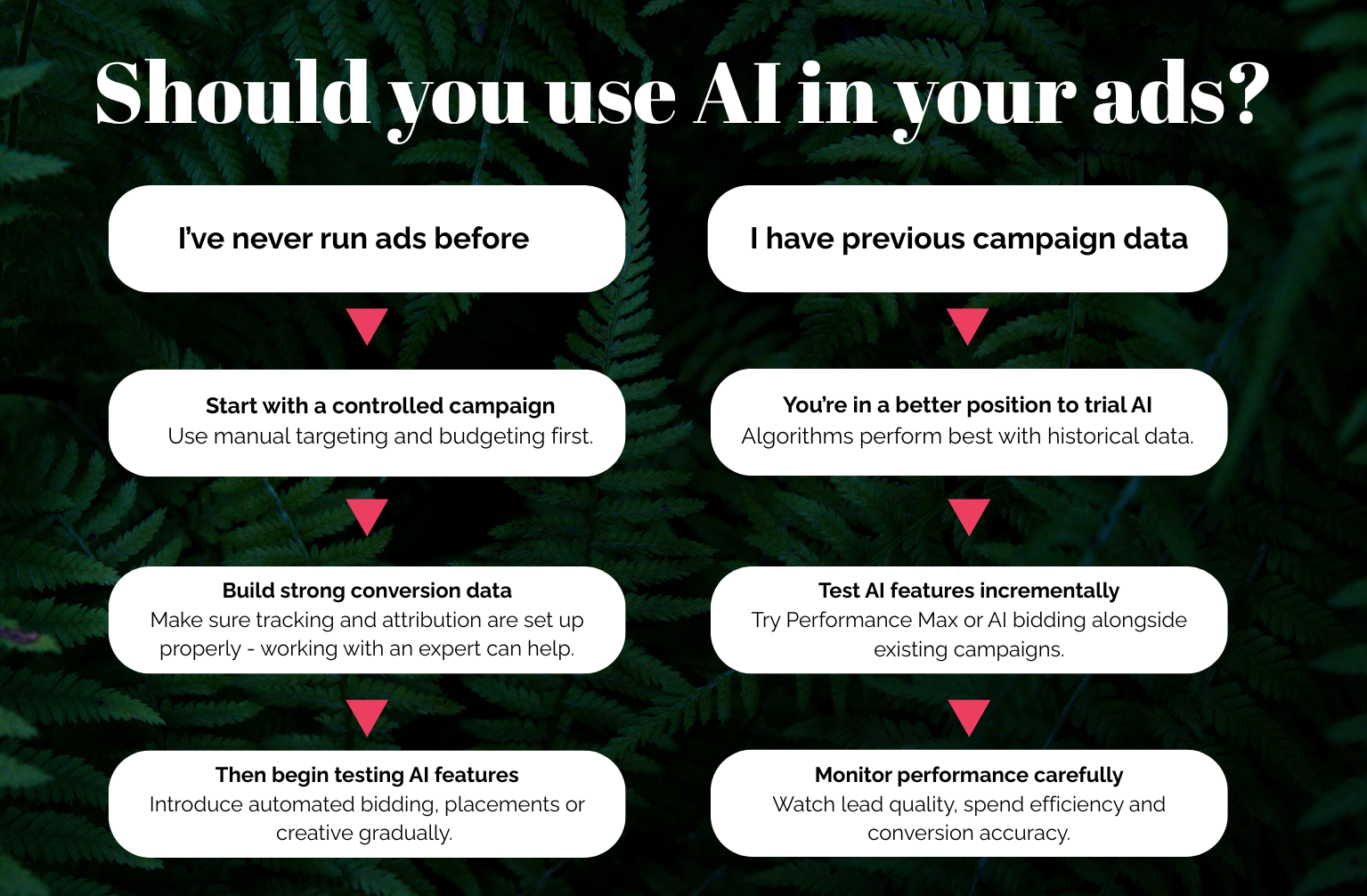
On Google, we run a lot of campaigns with Performance Max. For some clients, we use Smart Bidding and AI Max. A couple of our e-commerce clients have benefited from Demand Gen approaches. But we also have other campaigns that require more granular control – for those, we use manual search campaigns, where every aspect of the campaign is controlled manually by our specialists. At the start of campaigns, we prefer to use manual campaign types so that we can ensure good conversion data is captured before utilising Performance Max – and where we do use PMax, we monitor campaign performance very closely.
At least at the moment, Google’s AI offering feels far stronger than Meta’s. While we occasionally use Advantage+ for audience or destination optimisation, we decline all creative optimisation suggestions, keeping the control of this firmly in our hands. Meta’s AI tools have compromised the UX of ads manager, and ad setup feels far clunkier now. AI settings we have turned off have been turned back on automatically without our input (we’re not the only ones – this has happened to other advertisers). Consequently, we’ve implemented stringent checks for our Meta campaigns to ensure that only the Advantage+ tools we’ve consented to activating are being used on our campaigns. It’s frustrating to have something that’s being pushed for its efficiency actually add cumbersome new processes to our advertising workflows.
Ultimately we are testing and researching all AI tools extensively before we ever implement them into a client campaign. Where we use AI tools, it’s always with the clear consent and knowledge of the client, and we monitor ad spend and performance thoroughly. Despite the proclamations of the platforms themselves, many of these products are in their relative infancy, being tested in real-time. We treat them as such, which is why all of our digital advertising campaigns are overseen and continually monitored by Myles, our cat-loving Head of Campaigns – whether they use AI or not.
Should you use AI in your digital ads?
It’s crunch time, and don’t hate us for saying this, but our verdict is… it depends.
No really, it does. Lots of people are loving the new AI features, while other advertisers don’t like or use them at all. But in general, if you are brand new to advertising and don’t have any solid data, we would strongly recommend running a manual campaign first so that you have complete control over your campaign. Once you get this performing and the algorithm has useful data to work with, you can start testing AI tools – and our recommendation would be Performance Max.
If you are starting a brand campaign and want to use AI, it’s really important to still work with an expert on setting up the ad account, initial campaign, and conversion tracking. Set-up is one of the most important aspects of digital advertising, and especially when you’re adding AI into the mix, it’s crucial to get it right.
We’re now offering advertising set-up and conversion tracking as a separate service to our usual ads retainers. We know more people will be using AI to run their own advertising, but if this initial set-up phase is not completed correctly – the ads will not work. And that applies whether you’re using AI or not.
Whether you’re brand new to the world of digital ads or you’re a long-standing Google and Meta warrior, we’re always happy to help with any and all advertising conundrums.
If you need to get your ads under control, want a bit of an audit, or simply want to get your conversion tracking sorted, get in touch.